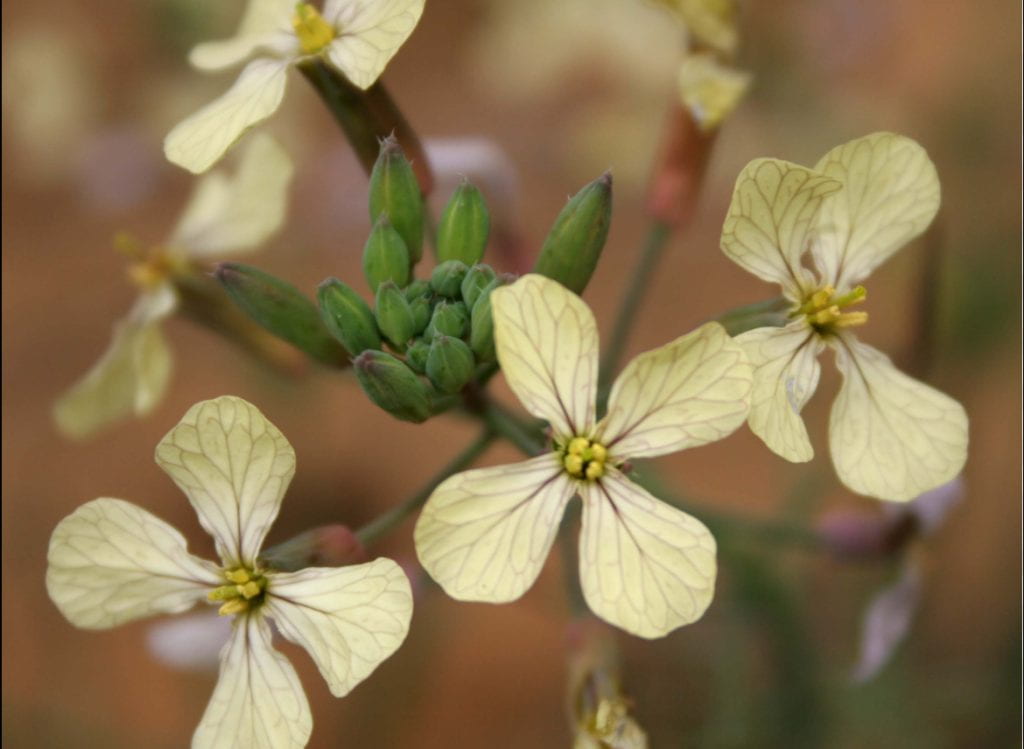
About a week ago I spotted pale yellow flowers on some weedy looking plants that were growing along the roadside in my neighborhood in downtown Columbia, SC. It was growing in hard clay soil behind a sidewalk on a heavily traveled road in an area where people sometimes throw their trash out of their car windows or just drop fast food cups and food wrappers as they walk by.
I could only see the flowers through the windshield of my car as I turned the corner heading to school that morning, but I immediately knew from the cross shape of the small four-petaled flowers what they were…. And what it meant when I saw them.
They were the flowers of a plant in the brassica family (a plant family that is also called the cruciferous vegetable family due to their cross-shaped flowers), and even though we had had snow fall here in the SC midlands about a week earlier, they meant that spring was on its way. These particular brassicas were probably wild radishes, but we will see yellow blanketing farm fields in coming weeks as wild cabbage, turnip, and radish plants begin to bloom. These plants are the descendants of crops planted here for hundreds of years that have been growing in farmers’ fields, open meadows, empty city lots, and roadsides ever since. These are brassica plants that originated as a wild mustard in Eastern Europe and Greece that people bred and crossed to make the vegetables we know as cabbage, turnip, radish, broccoli, kale, kohlrabi, and many more. They have grown where their seeds have blown for generations after they escaped farmers’ fields over the years and every spring some of them bolt and put on a light to dark mustard yellow colored show.
But wild brassicas aren’t the only flowers that let us know that the days are getting longer as the Earth tilts its top half (The Northern Hemisphere) back toward the sun and spring draws near. There are a number of “wildflowers” that you’ll see blooming in large numbers in agricultural fields this time of year turning the land into a blur of color as you speed by on your way down the highway in your car.
I’d like to introduce you to some of them so that if you are taking a road trip with your family and you’re looking out the window, you might be able to guess at what plants are putting on that show for you painting the landscape colors and providing some of the first nectar for bees and other pollinators as they come out of hibernation, hatch, or emerge from chrysali or cocoons and start to forage.
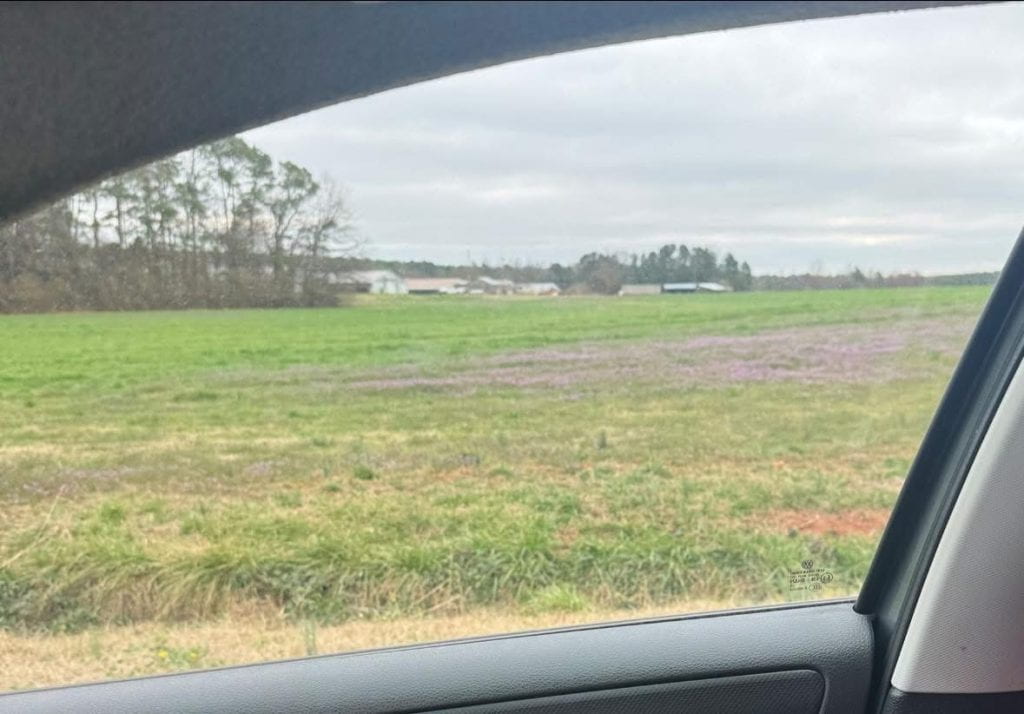
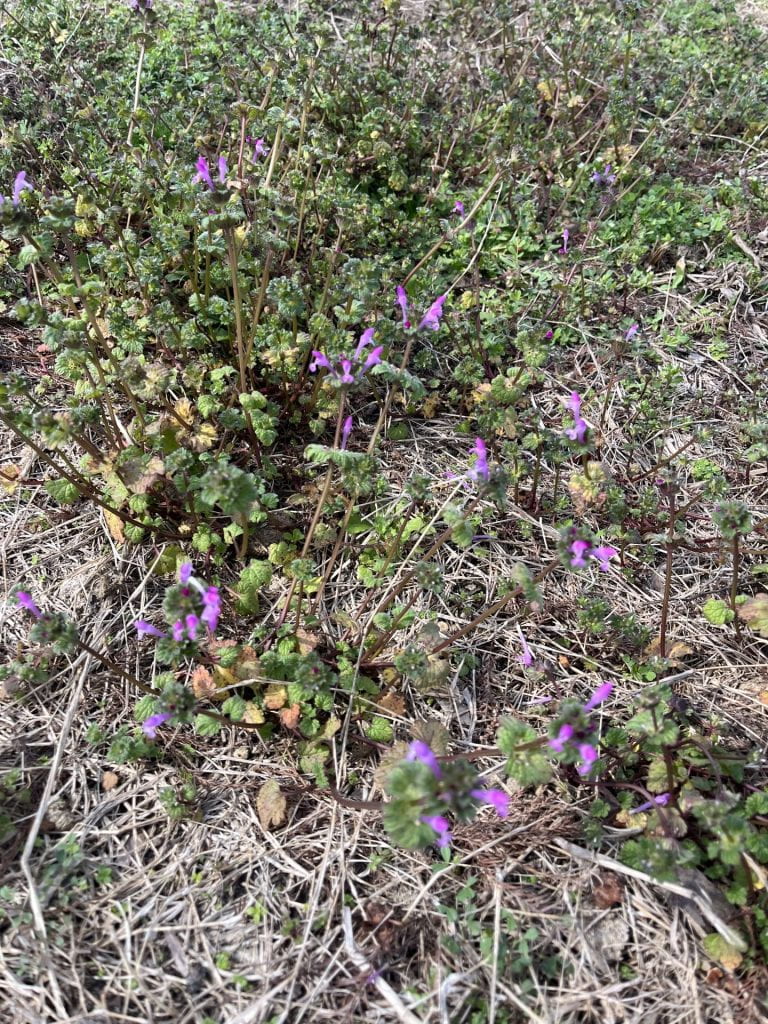
The light purple steak you see in the middle of this picture is either Henbit or Purple Dead Nettle. Both of these plants are in the mint family and while Purple Dead Nettle is from Europe and Asia, Henbit also originally grew in North Africa. You may have guessed that the wild brassicas are edible, but you might not have thought about eating these low-growing plants with slightly fuzzy dark green to purplish leaves. Well, guess what? You can! In fact the name “Henbit” comes from the fact that chickens will eat this plant if they find it in a farm field!
As the weather continues to warm we will see more flowers grow and bloom along our roadsides and in our fields. As I see these changes this Spring, I will take pictures and post them here with a description of each plant, so check back to learn more about the plants that let us know spring is coming.
The word “chit” refers to a piece of a seed potato that has an eye on it from which an entire plant can grow. The process of cutting your seed potatoes into chunks with viable eyes on them is called “chitting” your potatoes. This process is a great way to grow the maximum number of potato plants from each of your seed potatoes.
The practice of chitting potatoes is fun and easy and it helps you extend your potatoes’ growing season by giving them a head start. Here’s how we did it at school this year.
Here’s what our chits looked like about 3 weeks later. The kids checked them out and I planted them after our garden club meeting.
Growing a garden lets you grow and enjoy vegetables and flowers you may never be able to buy at the store. If you are a reader of our blog you know that many of the vegetables that our kids at MGES like best are the unusual ones you don’t normally find in the grocery store or even at farmers markets like cucamelons and ground cherries.
This year we will be adding new varieties of tomato, okra, spinach, pumpkin, corn, and flowers to our school garden as well as a very unusual watermelon.
Check out some of what Señor Frank has bought so far for our 2025 garden and check back from time to time since he will update this post as he finds more seeds for us to try growing this year!
These poppies are planted in the boxes in front of the school. There are also larkspur flowers and other colors of California poppies seeded in these beds.
I like to plant lots of different kales with different shaped and colored leaves in our garden. It makes the garden look good and the darker colored and purple leaves are more nutritious than regular kale.
the Love in a Mist flowers are something I’ve always wanted to try growing. They look delicate but I have heard they are easy to grow.
The Incredible Escalator zucchini seeds are pretty rare and hard to find. This zucchini grows on a climbing vine. It will be the only squash we grow on the trellis in beds 2 and 4 on the south side of the building. I hope it is successful since I would like to let some of the squash grow really large and let them mature so we can collect seeds from them. Those seeds would be good for trading with other gardeners since they are so rare.
This is our first order of seeds from Baker Creek Heirloom Seeds for the 2025 season. We are waiting on a second shipment right now.
This one includes a new variety of spinach that we need to plant right now, a new orange tomato (my favorite kind!), two okra varieties we have never grown before, a type of snow pea that grows 8” long pods, a Mexican Blanketflower with multicolored double flowers, and, of course, our yellow “pumpkin watermelon” Royal Golden that has yellow leaves and grows melons that turn golden yellow when they’re ripe. The melons will be part of our 3 sisters garden in bed 6 on the north side of the building.
I had forgotten ordering these tomato seeds. They came from a small seed company that specializes in tomatoes. I have wanted to grow Ildi yellow cherry tomatoes for two years now. They were the first tomato I grew in the garden at Carolina Springs Elementary back in 2011. Last year I ordered seeds for them from someone who was selling them on EBay. Those seeds turned out to be regular red plum tomato seeds. (I won’t buy seeds from EBay anymore…)
The Big Cheef tomato is a variety that Rick Padgett grew last year for the first time and said was one of the best tomatoes he has ever grown. He said it had excellent flavor and was a tough plant that produced a lot of fruit. Rick is the gentleman who donated the rototiller to our garden program last year. This year that tiller will be used to help us install the new garden at Meadow Glen Middle School! Thank you, Rick!
The white cherry tomato seeds were a free bonus pack that the company sent us! It’s always fun to order from smaller, lesser known companies. Often they will include a free pack of seeds for a vegetable that you might have never considered growing in your garden. And sometimes those free seeds end up being something you fall in love with and want to plant every year! (Sort of like the Ildi cherry tomatoes – the first plants we grew at Carolina Springs were donated to us by a small garden shop called “Birds and Blooms” in Chapin, SC!)
I bought this bag of Crimson Clover seed at Ladd Farm Supply, a seed and feed in Cartersville, Georgia. Crimson Clover is a legume that is used as a cover crop on farms since it fixes nitrogen in the soil. It also grows about 18” to 24” tall and produces bright red flowers that attract bees and butterflies. I hope to scatter a bunch of these seeds in some empty space in our pollinator garden to create a small meadow that the pollinators can enjoy this spring. When the plants are done flowering they can be pulled up and composted adding nitrogen to our compost.
This is our second Baker Creek Heirloom Seed order. We have four new flower varieties in this order. One is a unique red/pink cosmos called Velouette Another is a dark reddish variety of orange cosmos called Cosmic Red. The Velouette cosmos will probably go in the flower garden on the north side of the building in the Kindergarten playground area. The dark orange Cosmoc Red cosmos will be planted in the boxes in front of the school along with seeds collected from the Mona’s Orange Cosmons we grew last year. The Incredible Seashells mix coreopsis will be planted near the building on the Kindergarten playground side of the building along with the regular yellow and brown plains coreopsis and Incredible Swirl plains coreopsis we planted there last year. We will add the Summer Jewels Red Sage to our pollinator garden. The sage is a half-hardy annual that likes heat and can tolerate dry soil. It sometimes survives the winter and grows back the following spring, but it also produces lots of seeds and can self-sow popping up as volunteer plants for years.
We bought three varieties of colorful daikon style radishes. They will get planted in the fall so that the roots grow long and plump. Planting these brassicas now would be a mistake since they would bolt and their roots would turn skinny, stringy, and tough as the weather gets warmer. These radishes can be a little spicy, but they are beautiful when sliced and are delicious pickled in rice vinegar with a little salt, pepper, and sugar.
We also have two new varieties of tomato in this order – Brown Sugar and Apricot Zebra. I am a big fan of brown tomatoes – they are usually a bit tart with a full, deep flavor – but I have never grown one successfully that I’ve liked. I’m also a big fan of orange tomatoes – they are less acidic than red tomatoes and are usually much sweeter. This variety is an orange tomato that was developed by crossing one of my other favorites that we will be growing this year – Green Zebra. I’m looking forward to growing it with its green ancestor in this year’s tomato bed.
I got these seeds from Rodger Winn. Rodger has a seed farm out in Little Mountain, SC where he grows vegetables and flowers to collect the seeds from them. He sells the seeds to seed companies that he contracts with to grow the varieties of plants they need seeds for.
Rodger grew the Mona’s Orange Cosmos we planted in our garden last year. I actually saw the flowers he collected the seeds from two summers ago when I went to visit his farm for a tomato festival he held there. I’d asked him for some of the seeds but he explained that he could not give or even sell me any of the seeds since they belonged to Southern Exposure Seed Exchange, the company that he had a contract with to grow them.
I visited Rodger yesterday at his farm to buy some yellow Granex sweet onion plants from him and reminded him about asking for the seeds. I explained that the orange cosmos seeds I had really been looking for were a darker orange variety called “Memories of Mona”. Well, it turns out Rodger was the farmer who grew out the seeds for that variety of orange cosmos for Southern Exposure Seed Exchange and he had an extra pack of those seeds leftover from that year. He gave me the pack for free!
We will plant these at the new Meadow Glen Middle School pollinator garden this year so that we can collect seeds from them. They will be the only variety of orange cosmos we plant there, so all of the seeds we collect from that garden should grow into plants that also have dark orange flowers.
This is our order from Mary’s Organic Seeds. We got two varieties of okra – Silver Queen – a white variety that Jason Roland says produces long, tender pods with good flavor, and Perkin’s Long Pod that is a smaller variety that grows to 3 or 4 feet tall and produces lots of smaller green pods. I also ordered Green Zebra tomato seeds from Mary’s as well as Ukrainian Purple. Green Zebra is a tomato variety that was developed in the 1980’s. Some people consider it to be an heirloom now. Green Zebra tomatoes stay green when they ripen. They are bright green on the inside and a darker green with yellow streaks on their skin when they’re ripe. They’re actually very tasty – sweet with a little bit of a tartness to them. Ukrainian Purple tomatoes are long and look like an Italian paste tomato (Roma), but they’re dark purple. Unlike Italian paste tomatoes, Ukrainian Purple tomatoes are indeterminate which means they keep producing fruit until the frost kills them in the Fall. Italian paste tomatoes are usually determinate which means they produce a lot of tomatoes all at once in the middle of the season and then the plant dies.
The lady in the pictures above is Madeline Hastings. Maddy started an urban farm in front of her house in Laurens, SC back in 2020. I follow her on Facebook and have enjoyed her posts and videos in which she shares what she and her farm helpers are doing on the farm.
Her most recent post – which you can see at the top of this page – asked her followers to share their favorite flower.
Well, asking a gardener what their favorite flower is can be harder for them to answer than asking a parent who their favorite child is! There are so many flowers to choose from and so many reasons why you might like them from their beauty, to their colors, to their scents, and even, sometimes, their flavors!
In my case, I have been gardening for 50 years, so I have had many favorites over the years. If you’d like to know what my favorites have been over the years, read my answer to Maddy’s post below:
My favorite flower? That’s an impossible question for me to answer. It’s changed over the years as I’ve moved from place to place and tried my hand at growing different ones in different locations.
Early on it would have been the combination of Lilly of the Valley and Lilacs that would bloom in overlapping succession along the driveway of my grandparents’ house in New York. The light purple and white clusters of sweet smelling flowers of the lilacs arched over the carpet of dark green pointed spade-like leaves with the intensely perfumed white bells drooping from their stems. The effect was a series of sweet smelling, open, airy green tunnels that ran down the entire side of the driveway along the house on the property line with the neighbor’s yard just past them.
Later when I moved to DC I enjoyed finding the Virginia Bluebells that bloomed in shaded areas along the Potomac River while fishing and had a years-long obsession with Bleeding Hearts attempting to get them established in my landlady’s back yard next to a stump in her side garden. I managed to get them to return for 2-3 years at a time, but they always died off.
DC and the Mid-Atlantic is also where I made the acquaintance of Japanese Anemones and native red and yellow columbines. To this day I’ve enjoyed admiring light pink or white Japanese Anemones whenever I come across them, but can’t really grow them successfully here in the Midlands of SC. Zone 8b is just too hot.
I do have some red and yellow columbines in our school garden now – they aren’t the natives I first saw in DC in a bed on the shady side of a house in my old neighbirhood that was 1/3 Shasta Daisies, 1/3 Anemones, and 1/3 Columbines (a great combo for continuous spring through fall blooms). My columbines were grown from seeds collected from plants with blue flowers that I planted three years ago. All I can figure is they were a hybrid cross that reverted to one of the parents’ traits.
In NC I came to love the Dogtooth Violets I’d find blooming along the creeks I’d fish near Durham. I’d read about them as a boy, but never saw any back home on Long Island where I grew up or in the Mid-Atlantic while I was there. I also managed to grow cultivated Lobelia (Cardinal Flower) for the first time successfully. The wild variety has also been a favorite of mine since first seeing it in upstate New York on a late summer trip to Lake George. I now look forward to seeing it bloom along the Lower Saluda River here in Columbia every Fall.
Since moving to the Carolinas I’ve also enjoyed the more tropical flowers like the Tea Olives – if only for their fragrance – and the White Butterfly Ginger Lilies for both their late summer showiness and scent that can be detected many feet away from the plant. I love seeing Hummingbird Moths feeding on the ginger lilies in the evenings. We have two clumps of this plant growing in our school pollinator garden, and we are looking forward to its first blooms next year.
But as I sat here on my couch writing this on this snowy, cold morning, I looked up and realized that the flower that probably fits best as my favorite is the poppy. My entire living room is poppy themed from the poppy paintings to the wall decal to the Fedco Seed catalog print with the pen and ink poppy illustration on it and the poppy coverd carpet. I guess they’re my favorite because they are the first flower I grew at my grandparents’ house in the garden space they gave me that wasn’t something anyone in my family had ever grown before. Those first poppies were California Poppies and I loved how the plants looked like little gray-green carrots to me. The bright orange satélite dish like flowers were a fun surprise popping out in the rows where I interplanted them with lettuce when I was 8 or 9 years old.
If you have read everything above, I have a question for you…. What is YOUR favorite flower and WHY? Answer this question in the comments.
And if you didn’t guess Maddy’s favorite flower yet, here are some more pictures of her and her son on the farm with those flowers.
And here is more information about Maddy’s farm, Hasting’s Corner up in Laurens, SC.
I just came across this video showing some of what we did to set up the school garden at Carolina Springs Elementary School back in 2012.
It’s easy to tell that starting this school garden was not a solo project. As I say in the video, Mayor Steve Benjamin of Columbia came through with free compost from the City of Columbia Compost Facility when I asked for it. This despite the fact that our garden wasn’t IN the City of Columbia or even in Richland County! Parent volunteers helped in raking out weeds and screwing together the walls of the beds, but I failed to mention that all of the lumber used to make those beds was donated to the school by Lacey Sutton of RH Smith Lumber Company in West Columbia. I approached a number of small (and large) lumber yards asking for donations, and when Mr. Sutton heard about our plans to grow fresh veggies with our students, he responded immediately. While the boards were a little warped – not good for most construction projects – and he did have to charge us a nominal $20 fee, we ended up with enough 2×10 lumber to create 8 garden beds that measured 3’ wide by 8’ long. He also threw in the deck screws and a driver bit for our drill for free! Lacey even cut the boards to length for us himself and told me that he wanted to support our efforts since gardening was something that he enjoyed doing with his granddaughter and he wanted other kids to have the opportunity to learn to grow their own food!
Even before anything you see in this video happened, our neighbor Sam showed up with his rear tine rototiller and tilled up the area where our garden was going to be as well as two other areas where we created a garden bed and a native wildflower meadow. I had asked to borrow the tiller so we could do the work ourselves, but Sam, who was probably close to 70 years old at the time, insisted on showing up on the Friday afternoon before our parent work day and tilled everything up himself spending hours tilling on a sunny nearly 90-degree day.
And as you can see, many other community members, leaders, farmers, and business owners helped along the way. In the video you can see that Mayor Halfacre of the City of Lexington donated the mulch we used to chip the pathways and Mr. Miller, our PE teacher, came out to help us spread the mulch.
But there were so many other community helpers and people who donated plants, seeds, and soil amendments over the years.
Our first tomato plants were donated by one Mrs. Alpine Zalewski (AKA: Pine) of Chapin, SC. Pine was 84 when I met her and running her own small greenhouse and store, Birds and Blooms Nursery. I stopped to chat with her every weekend on my way home from my wife’s house back when we were dating. I would let her know how things were progressing in the school garden and ask her advise about different issues as they arose with our plants. She ended up donating a full flat of what turned out to be Ildi yellow cherry tomatoes that she had forgotten to label and couldn’t sell as a result in April of 2013. Those were some of the tastiest and highest-yeilding cherry tomatoes I’ve ever grown! I’ve actually ordered seeds for this tomato variety so we can grow them again this year!
Randal Isherwood of Gardener’s Outpost, a small garden and exotic plant shop in Columbia, supplied us with fall brassica plants like broccoli and kale and amendments like Happy Frog potting soil and Fox Farms organic fertilizers.
Dot Derrick gave us a flat of 48 Red Russian Kale plants one year that she said her son was not going to plant on his farm in Newberry. Growing and roasting that kale made me a kale enthusiast who now encourages kids and adults alike to grow and eat this easy, delicious, healthy vegetable. Dot also taught me how to mulch with paper and wheat straw, a tip that I’ve used to good effect for years now to cut down on water use in the summer and ELIMINATE weeding in the summer garden.
One year WP Rawl Farm donated 150 bare-root kale plants.
Greg Brown of Green Leaf Farms donated seeds and plants from his farm that added to the beauty of our pollinator gardens providing years and years of flowers as we collected those amaranth seeds every fall.
Jason Roland of Organically Roland Farm donated kale plants right out of his field one year and many, many plants and seeds over the years as well as invaluable advice, suggestions, and encouragement.
And Sallie Sharpe of Sal’s Ol’ Timey Feed and Seed sent us monthly seed boxes containing seeds, bulbs, information sheets for planting, and fun “extras” – little toys and stickers that went with the monthly theme that the kids loved!
There were so many other contributors – more than I can remember or name here. People who donated plants at plant swaps – always offering their advice to help us get our newly adopted plants off to a good start. Members of online gardening groups who shared seeds through the mail sending instructions for how to grow what they sent as well as cultural notes about where each plant came from and how it was used or cooked. Many times they also sent personal stories of their family’s history and how the plants came to be part of their gardens and diets. An example of this would be when Amanda and Joe Jones donated a jar of collard seeds they had found in Joe’s grandfather’s shed that were 30 years old! The seeds were some of the last ones of a locally famous variety and the Jones’ hoped we could get some of them to grow so we could collect more seeds from the plants and possibly bring back a collard variety that was a family heirloom!
The point is, if you haven’t figured it out already, a school garden is a collaborative effort. If you are a teacher who wants to start a successful educational garden at your school, I encourage you to reach out to local community members who might be interested in helping you. You will be surprised at the amount of support you get from many different sources. Don’t be shy. Get started getting to know your local small farmers. Get involved in gardening communities either in person by joining gardening clubs, or online through social media gardening groups. Talk to the people who own or run local nurseries or landscaping outfits. Before you know it, you will have community around you that supports your program and your goals of teaching children where their food comes from and the skills and knowledge needed to grow that food!
Being a gardening educator can be a lot of fun. Much of what happens in the garden is so engaging for the kids that it can seem magical to them.
Of course, a big part of our job as gardening educators is to explain the science behind the magic they see among the plants every day.
But having a garden also gives us opportunities to play and work with the imagination of our students.
One of my favorite seasonal projects in the school garden is making my plants “talk“ by planting a “secret word“ in the fall or the spring.
To do this, I first ask my students if they knew that plants could talk… In fact, as the Spanish teacher, I let my students know that MY plants are bilingual! They speak both English and Spanish!
Then I get to work planning out a spot I can use to spell out a garden-related word in a garden bed. I try to choose words that are not too long. I trace the letters in a prepared bed with my finger, then sprinkle seeds thickly into the lines I’ve made. When I’m done, I gently brush soil over the seeds and water them well. I always use seeds that I either bought in bulk or that I’ve collected in years past that I have extra of. I find that small seeds that sprout quickly and are easy to grow are best. Lettuce, kale, mustard greens, or even amaranth are good choices.
Once my word is planted, I remind my students that the plants are working to spell out a word every chance I get! We take walks to the spot where the word is planted to see how the plants are doing and if anything resembling letters is starting to appear in the soil.
When it becomes clear that letters are forming in the soil, the kids always ask how I did it. I tell them that I had nothing to do with it! I simply “taught” the seeds a word by whispering it to them as I held them in my hand and then threw them into the garden where I wanted the word to appear and, of course, the seedlings arranged themselves into the letters to spell out the word!
I find that most of the older kids see through my ruse quickly, but the younger ones are wiling to believe – sometimes all the way up to 3rd grade! And the older kids who are in on the joke usually appreciate it and avoid spoiling it for the little ones.
In fact, I sometimes have my garden club kids help me plant the word so they are in on the joke and swear them to secrecy! The garden club kids love having this little secret and being able to spread the word that their plants are super smart bilingual plants that can spell out words in two languages! They will share this information with parents, teachers, administrators, and support staff at your school besides telling all their friends about it. It’s a great way to build interest in your school garden!
So far I have had my plants spell out words like “flor” (flower), “verde” (green), and “primavera” (spring). In fact, since I’m teaching at a school with a Mandarin immersion program now, I taught the plants to write the Mandarin character for “spring” too!
But my favorite word has to be “lechuga” (lettuce), which I planted back in April of 2013 at Carolina Springs. The following video shows the progression of the word as the seedlings came up over the course of weeks followed by a video one of my garden club students took after she asked to use the digital camera…
Having kept a school garden for over a decade, I can tell you that kids love growing vegetables. The act of planting a tiny seed and watching it grow into a large plant that you can pull out of the ground and eat like a carrot or radish, or that produces edible leaves like lettuce, cabbage, or kale, or that produces a fruit like a tomato or ground cherry is like magic to them.
And while average generic vegetables are fun to grow, kids really love growing the vegetables that go to extremes like tiny sour cucamelons or strange, spicy rat tail radishes, or odd colored tomatoes like Brad’s Atomic Grape.
But when it comes to the extreme vegetables, it’s hard to beat the giants! What kid doesn’t love to see a giant pumpkin that weighs more than they do and that they can sit on? Who will ever forget their first giant sunflower – even if it only grew at tall as the adults in their families? And while that zucchini might be tough after it stays on the vine too long, a child will take pride in growing a squash that approaches the size and texture of a baseball bat! (I once grew a “big top” carrot that was so thick and squat that the kids asked if it was a sweet potato when we pulled it up!)
A few years ago (2021) Sallie Sharpe of Sal’s Ol’ Timey Feed and Seed sent us giant beet seeds in our monthly seed box. In the box was a note explaining how to plant the seeds and that there would be a contest among the seed box recipients to see who could grow the biggest beet! I was at a different school then, but we planted and grew out those giant beets along with a few giant radishes.
it’s not hard to grow beets. Just plant the seeds in rich, well drained soil at the right time of year. We grew ours in a raised bed garden box we built ourselves. We planted ours in September, but the Clemson garden planning guide shows a spring planting window that goes from February 15 to March 31 too, so it will be time to get those beets in the ground soon!The information in the two boxes on the left is for the coastal region of SC which covers roughly from Columbia to the coast. The two boxes on the right are planting times in the upstate, or from Columbia to Greenville and beyond to the northwestern border of SC.
The kids really got a kick out of growing and pulling up these giant root vegetables, and they had a surprise guest when harvest day arrived – Sallie Sharpe came to visit our garden and watch us pull them up!
Tue kids were so proud of their beets and radishes, and they enjoyed meeting Sal and showing her the garden and what they had grown with her seeds!
And Sal is holding another giant beet contest again this year! She is offering giant beet seeds to any school garden that would like to participate for free! If you’re a teacher with a school garden, I encourage you to give her a call at the shop at (803) 786-6546 and ask for some. The kids at your school will enjoy the activity and they’re sure to be impressed and surprised by the size of the beet root they grow no matter how big it gets!
Last night I went to the hardware store and as I walked past this printing shop I noticed they had a lot of houseplants growing in their window. When I realized what this plant was, I had to take a pictures. This is probably the biggest one of these I’ve ever seen, and I’ve seen them growing outside planted in the ground in Florida!